How to store and protect cards
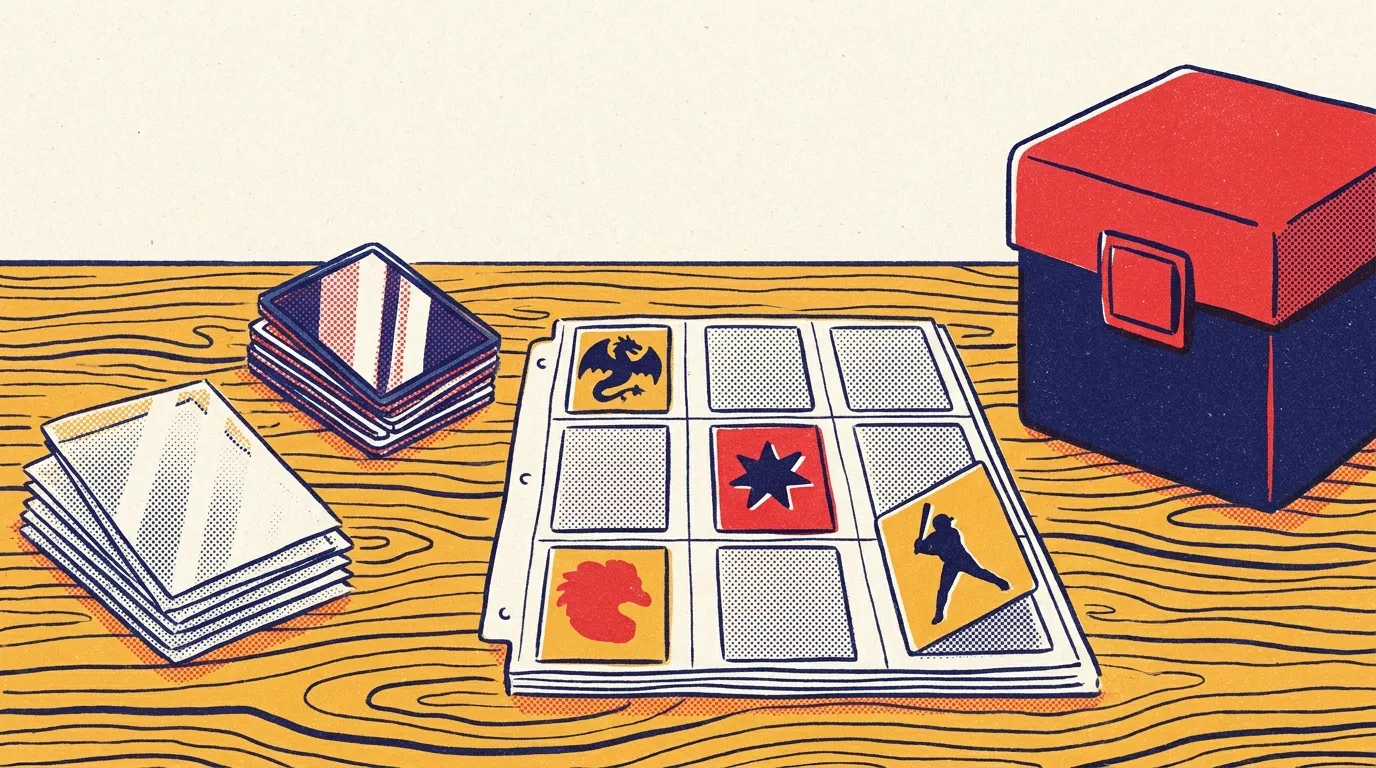
Cards are printed on thin card stock. They bend, scratch, warp and fade more easily than most people expect. A card's condition drives most of its value, so the right storage pays for itself the first time it saves a good card.
The good news: card storage supplies are cheap, standard and sold at almost every card shop. Here is what each one is for, and how to set up a collection that stays in good shape for years.
Handle cards the right way first
- Wash and dry your hands before handling valuable cards. Skin oils and lotion leave marks on the surface.
- Hold cards by the edges, not the face.
- Don't slide unsleeved cards across a table. Grit scratches the surface, especially on holofoils.
- Keep food and drinks away from the table when you sort.
- Never put rubber bands around stacks of cards. They dent the edges of the top and bottom cards.
The basic protection kit
Penny sleeves
Penny sleeves are thin, soft, clear plastic sleeves. They're the first layer for any card you care about. They protect the surface from scratches and fingerprints and make the next layer safer to use. Buy sleeves labeled acid-free and PVC-free.
Toploaders
Toploaders are rigid clear holders that a sleeved card slides into from the top. They keep a card flat and protect it from bending. The common 35pt size fits a standard card. Thicker cards, such as jersey, patch and some memorabilia cards, need thicker toploaders, so check the card's thickness before you buy.
Always sleeve a card before it goes into a toploader. A bare card can get scratched sliding in. Many collectors also put the toploader in a small resealable "team bag" to keep the card from sliding out.
Semi-rigid holders
Semi-rigid holders are flexible plastic holders, a little softer than a toploader, with a wide opening. They're the standard way to send cards to grading companies, because graders can remove cards from them easily. If you plan to submit a card, store it this way. Our grading guide covers submissions.
Magnetic and screw-down holders
For your best cards, a thick magnetic "one-touch" holder looks good on a shelf and offers strong protection. Some have UV-protective plastic. Old screw-down holders can press on a card if over-tightened, so magnetic holders are the more common choice today.
Deck sleeves
If you play, use deck sleeves, which are thicker and often colored on the back. They let you shuffle without damaging cards and keep your deck uniform. Most games, including Pokémon, Magic, Lorcana and One Piece, use standard-size sleeves. Yu-Gi-Oh! cards are smaller and need small or "Japanese-size" sleeves. Serious players often double-sleeve: a tight inner sleeve, then a deck sleeve over it.
Binders: good for display, if you pick the right one
Binders let you see your collection and show it to friends. They're great for completing sets. The wrong binder, though, can damage the cards inside.
- Choose side-loading pockets. Cards slide in from the side, so they're less likely to fall out when the page is turned or tipped.
- Avoid PVC pages. Soft PVC pages can release chemicals over time that damage cards. Look for pages made of polypropylene and labeled acid-free and PVC-free.
- Skip cheap ring binders for valuable cards. Rings can press into the cards closest to the spine. Binders with pages built in, often with a zipper closure, avoid that problem. If you do use a ring binder, choose D-rings and don't overfill it.
- One card per pocket. Two cards in a pocket rub against each other and stretch the pocket.
- Store binders upright, like books on a shelf. Stacking heavy binders flat can press marks into the cards.
For valuable cards, sleeve them before putting them in a binder pocket, or keep them in toploaders instead.
Storage boxes for the bulk
Most collections are mostly commons and uncommons. You don't need to sleeve each one. Store them in cardboard storage boxes made for cards, sold by how many cards they hold. Long "row" boxes hold large collections in single or multiple rows.
- Store cards upright, packed snugly but not crammed. Loose cards slide and bend; overfilled rows crush edges.
- Use dividers to separate games, sets or teams. Labeling dividers makes lookups fast.
- Keep the box lids on to keep out dust and light.
- For extra protection, put the cardboard boxes inside a plastic bin with a lid.
Deck boxes are made for decks you play with. They're fine for that, but they're not the right home for a long-term collection.
Heat, humidity and light: the real enemies
Most serious card damage isn't from handling. It's from where the cards were kept.
Humidity
Card stock absorbs moisture. Damp air makes cards curl and warp, and it can cause mold and stains. Foil cards are especially prone to curling. Avoid basements and anywhere near water pipes. If your home is humid, keep cards in sealed plastic bins with silica gel packets, and replace or recharge the packets as directed.
Heat
Heat can warp cards and sealed packs and can make plastic holders cloud. Don't store cards in attics, garages, sheds or cars. A hot car can damage cards in a single afternoon. Room temperature, in a stable spot, is the goal.
Light
Sunlight fades ink over time, and the damage can't be undone. Keep displayed cards out of direct sunlight. UV-protective holders and display cases help, but a shaded spot is the cheapest protection.
The best spot in most homes
An interior closet or a shelf in a room you live in: dark, dry, off the floor and away from exterior walls. If something leaks, cards on the bottom shelf get wet first.
Storing sealed product
Sealed boxes and packs need the same cool, dry, dark conditions. Keep the factory wrap intact if you want the product to stay sealed. Store boxes so nothing heavy sits on top of them, since crushed corners and dents lower the appeal of sealed product.
Keep an inventory
For a valuable collection, keep a simple list or spreadsheet of your key cards, with photos. It helps you track what you have, makes it easier to sell later, and is useful if you ever need to file an insurance claim. Ask your insurer whether your home or renters policy covers collectibles, or whether you'd need extra coverage.
A simple setup that works
- Bulk commons in labeled storage boxes, inside a lidded plastic bin.
- Cards you want to look at in a side-loading, PVC-free binder.
- Valuable cards in a penny sleeve and a toploader, stored upright in a box.
- Cards you'll grade in a penny sleeve and a semi-rigid holder.
- Everything in a cool, dry, dark room in the living part of the house.
Any local card shop sells these supplies and can help you pick sizes. Find one in your area with card shops by state, or browse shops by game.