How to sell your card collection
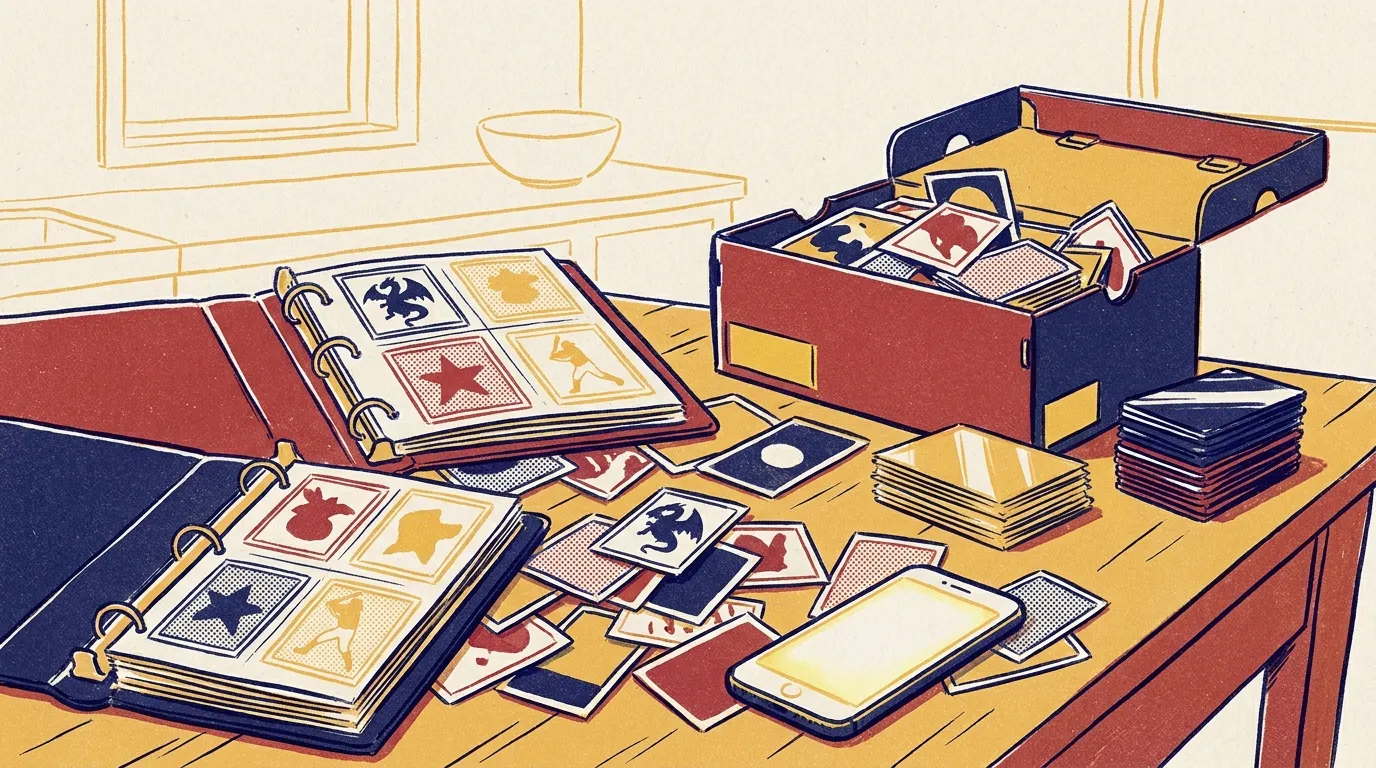
Maybe you're thinning out a Pokémon binder, quitting Magic, or cleaning out a closet full of sports cards from the 1990s. The process is the same either way. Sort what you have, find the few cards that carry most of the value, then pick the place to sell that fits how much time you want to spend.
This guide covers all three steps. It doesn't quote prices, because card values move every week. It shows you where to look them up yourself.
Step 1: Sort before you do anything else
An unsorted box is hard to price, for you and for any buyer. A buyer who can't see what's inside will price the whole box as bulk. Sorting takes an evening and protects you from that.
- Split by game or sport. Pokémon in one pile, Magic in another, baseball in a third. Buyers often specialize, and some shops only buy one or two games.
- Split by set or year. Most cards print a set symbol or a year and a card number on the front or back. Grouping by set makes lookups fast.
- Pull anything shiny, numbered, signed or old. Holofoils, full-art cards, serial-numbered cards, autographs and memorabilia cards go in their own stack.
- Leave the commons together. Common and uncommon cards are usually sold as bulk. You don't need to look each one up.
Handle cards by the edges and keep them off rough surfaces. If you find a card that looks valuable, put it in a penny sleeve and a toploader right away. Our storage guide explains the supplies.
Step 2: Find the cards that matter
In most collections, a small number of cards hold most of the value. Your job is to find them before a buyer does. Here is what to look for in each hobby.
Pokémon
Check the rarity symbol in the bottom corner: a circle is common, a diamond is uncommon, and a star is rare. Look for holofoils, full-art and special illustration cards, and older cards from the early sets. Cards from the original 1999 Base Set with a small "Edition 1" stamp are worth checking carefully. Japanese cards are collected too, so don't toss them.
Magic: The Gathering
The set symbol's color shows rarity: black for common, silver for uncommon, gold for rare and orange-red for mythic rare. Many valuable Magic cards are rares that see play in popular formats, not just old cards. Foils, alternate-art versions and older cards from the game's early years are also worth looking up.
Sports cards
Look for rookie cards (modern ones carry an "RC" logo), serial-numbered cards stamped with something like "/99", autographs, and cards with a piece of jersey or patch. Vintage cards of star players are worth checking even in rough shape. A lot of mass-produced cards from the late 1980s and early 1990s are common, so check before you assume.
How to check what a card is worth
Look at what the card has actually sold for, not what sellers are asking. Asking prices are wishes. Good sources:
- eBay sold listings. Search the card, then filter by sold items. Match the exact card, set, version and condition.
- TCGplayer for Pokémon, Magic, Yu-Gi-Oh!, One Piece, Lorcana and other game singles. It shows recent sales and a market price.
- Price guides and sale trackers such as PriceCharting and sold-price aggregators for sports cards.
Condition changes value a lot. Game cards are usually sold as near mint, lightly played, moderately played, heavily played or damaged. Look at corners, edges, surface scratches and whitening on the back. Be honest with yourself; a buyer will be.
If a card is valuable and in excellent shape, it may be worth grading before you sell. Grading costs money and takes time, so read card grading, explained before you decide.
Step 3: Choose where to sell
Each option trades money for time and risk. Many sellers use more than one: the best cards go where they get the most, and the rest goes where it's easiest.
A local card shop
Selling to a shop is the fastest option. You walk in with cards and can walk out with cash or store credit the same day. No photos, no shipping, no buyer disputes.
The trade-off is price. A shop has to resell your cards, pay rent and staff, and hold inventory that may sit for months. Expect an offer below what the cards sell for online. That's normal, not a rip-off. The question is whether the speed and certainty are worth the difference to you.
Shops are also the best home for bulk. Many buy commons and uncommons by count, which is rarely worth doing online once you add shipping. To find shops whose reviews or own website say they buy collections, browse shops that buy cards by state and city.
Online marketplaces
eBay, TCGplayer and similar sites reach the most buyers, so the most valuable cards usually sell for more there. You do the work: photos, listings, packing, shipping and the occasional return. Selling fees and shipping costs come out of your price, so check them before you list.
Selling online makes the most sense for individual cards worth enough to justify that effort. For low-value cards, fees and postage can eat most of the sale.
Card shows
A card show puts many dealers in one room. That lets you get several offers in an afternoon and compare them. Shows are especially useful for sports cards and graded cards. Bring your collection organized, know your numbers, and don't accept the first offer if it doesn't feel right.
Buylists and mail-in buyers
Some stores and websites post a buylist: a public price they will pay for specific cards. You mail the cards in and they pay after checking condition. It's simple for game singles, but read the condition rules first. A card they grade lower than you did gets a lower price.
Cash or store credit?
Many shops offer more in store credit than in cash. Credit costs the shop less because you spend it on their inventory. If you're going to keep playing or collecting, credit is often the better deal. If you're leaving the hobby, take the cash.
Ask both numbers before you agree. Also ask whether credit expires and whether it applies to singles, sealed product and event entry.
What to bring to the shop
- A photo ID. Many shops ask for one when they buy, and some areas have secondhand-goods rules that require it.
- Your cards, sorted. Valuable cards sleeved and in toploaders, bulk grouped by game and set.
- Your own price notes. A short list of your key cards and their recent sold prices.
- Time. A careful buyer goes through cards one at a time. A large collection can take a while.
Call first if you have a big collection. Some shops only buy on certain days or when their buyer is in. Some only buy certain games. A phone call saves a wasted drive.
How to get a fair offer
- Ask how they priced it. A fair buyer will price your best cards one at a time and make one offer on the rest.
- Get more than one offer for anything valuable. Prices can vary from shop to shop.
- Split the collection. You can sell the bulk to a shop and keep the top cards to sell yourself.
- Be clear about condition. Pointing out a crease before the buyer finds it builds trust.
Red flags
- A buyer who offers one price for a whole box without looking through it.
- Pressure to decide right now, or an offer that's "only good today."
- A buyer who won't let you watch them go through your cards.
- Online buyers who ask you to ship before payment clears, or to accept payment in a way that skips the platform's protection.
- Strangers in a parking lot outside a shop or show offering to buy before you get inside.
When you ship cards you sold online, use tracking, and consider signature confirmation for expensive cards. Keep proof of each sale.
Selling an inherited collection
If you're selling cards for a family member, don't clean them, don't break open old sealed packs, and don't pull cards out of old plastic holders. Original packaging can matter. Sort what you can, look up the cards that stand out, and get more than one opinion before you sell anything that looks old or special.